Building a site out of several blocks
Two Hughes blocks, six dwellings, $274,000 of Lease Variation Charge. Consolidated, the same six cost $133,500 — and a seventh still costs less.
Canberra infill is screened one block at a time, because that is how blocks are sold and how every public tool is built. It is also how the best sites get missed. Since MPA 04 the block next door is not a different opportunity — it is part of this one, and the arithmetic of adding it is not intuitive.
This page is about what a site made of several blocks does to the numbers, what this tool will tell you about one, and — just as much — what it refuses to.
The case
An agent brought a pairing the tool could not screen: two adjoining RZ2 blocks with a builder proposing seven terraces across them, and an open question about whether the result could be subdivided or would have to be unit titled. Every part of that except the titling is arithmetic this tool already did. The part it could not do was the first step — establishing that the two blocks actually adjoin.
The worked example below is a different pair, in Hughes, chosen because both blocks already carry an approved multi-dwelling application. Live acquisitions do not get published here.
Why the charge falls as the site grows
Section 9(2) of the determination charges the increase in dwellings at the rate for the total. Consolidating acts on both halves of that sentence at once. It pools the existing dwellings, so the base is two rather than one. And it pushes the total into a cheaper Schedule 2 band, because the rate falls as the count rises.
Hughes is at the strong end of this, because its rate more than halves between the three-dwelling band and the five-to-ten band. The effect itself is ordinary: in 85 of the 105 suburbs in Schedule 2, seven dwellings on a consolidated pair cost no more than six across the two blocks separately, at a median saving of about $13,000. Those are amounts payable under the missing middle remission; the codified charge, which is what drives the implied uplift, is twice each of them.
What the tool does
It measures the boundary instead of guessing at it
Every block page offers the blocks that genuinely share a boundary with it, measured from the cadastre edge by edge — not inferred from how close two address points are.
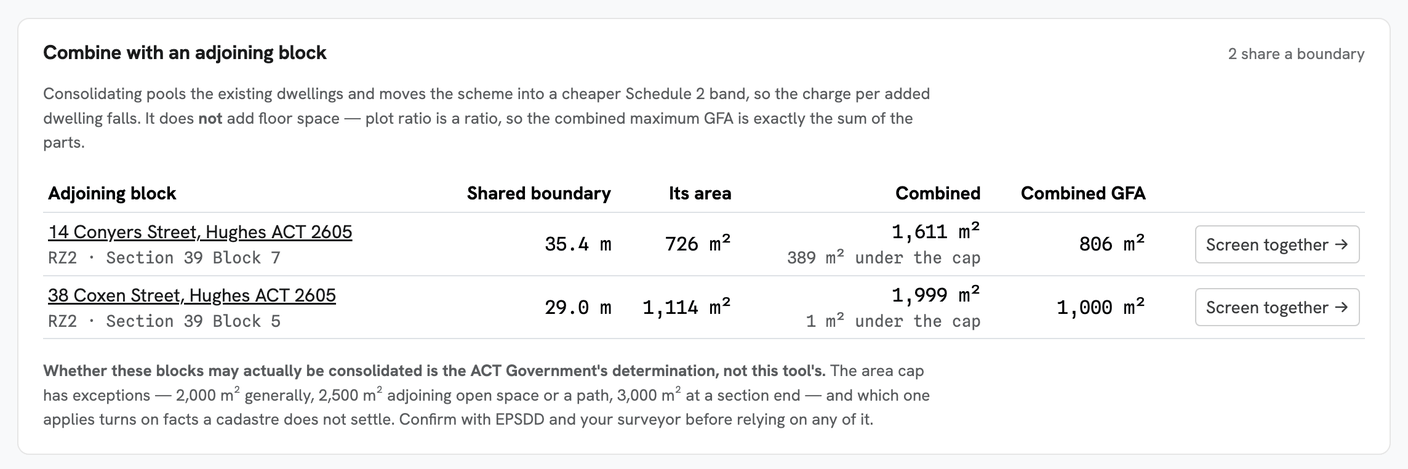
The distinction is not academic. The third and fourth closest blocks to this one are across the road — near by any measure, and impossible to build across. On the pairing that prompted this feature the failure ran the other way: the block it actually adjoined ranked seventh by centroid distance, behind five blocks sharing no boundary with it at all, because both were corner blocks whose address points sat at opposite ends of the line they shared. Blocks meeting at a single corner point are excluded too, since you cannot build across a point.
It screens the combination as one parcel
Choose one and the pair is screened as a single piece of land. Area summed, unimproved value summed, existing dwellings summed, frontage unioned across every street the parcel now touches, and the full Lease Variation Charge and residual land value model run over the result — the same calculation the single block gets, not a second one written beside it.
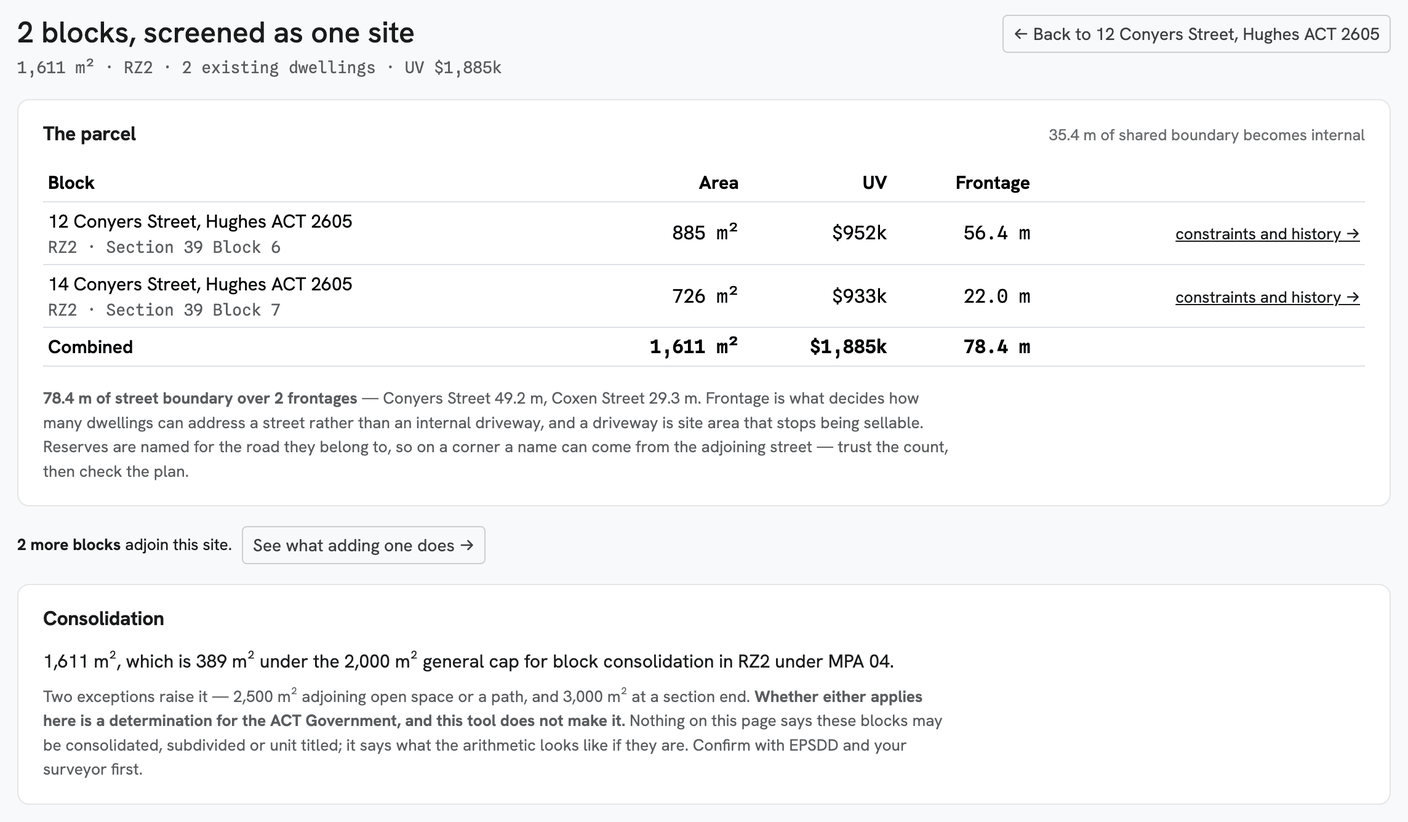
Nothing is stored. A site is something you construct in a URL, not a record — keeping one would make this a database of who is circling which blocks, and that is the most commercially sensitive thing this application could know.
What it will not tell you
| It says | It does not say |
|---|---|
| These blocks share a 35.4 m boundary | That they can be consolidated |
| Combined area is 1,611 m²; the general cap is 2,000 m² | That this combination is permitted |
| The site fronts two named road reserves | That every dwelling can be given street access |
| Indicative GFA at 0.50 is 806 m² | That a scheme of that size would be supported |
| Unit titling and separate leases carry different fees and different end values | Which one this scheme would get |
Three refusals are worth stating rather than burying:
- Whether you may consolidate. The general cap is 2,000 m², but 2,500 m² applies adjoining open space or a path and 3,000 m² at a section end. Which one applies turns on planning terms whose application is the Territory's to make. The tool reports all three and stops.
- What you can build on it. Consolidation does not add floor space: plot ratio is a ratio, so the combined maximum GFA is exactly the sum of the parts. Worse, that figure is guidance rather than a cap — site coverage is the mandatory Assessment Requirement now, and this model does not compute it. On a constrained parcel site coverage will bind first.
- How it would be titled. Unit title against separate Crown leases turns on whether each dwelling can sit on its own parcel with independent access and services. That is a surveyor's call on a site plan, not a call a cadastre row can make — and the value gap between the two is real, so it is modelled as two end-value scenarios rather than decided.
And one the data cannot reach at all: the tool knows nothing about ownership. Every block listed as adjoining is a block that adjoins. None of them is a block that is for sale, and nothing here tells you whether the lessee next door has any interest in talking to you.
RZ2 before RZ1
Consolidation is permitted in both zones, under the same caps, with the same remission and the same 0.50 plot ratio. It is still the better bet in RZ2, for three reasons that compound.
The extra storey. RZ1 is two storeys plus attic; RZ2 multi-unit housing is three storeys plus attic. Identical plot ratio means identical floor space — but in RZ1 that floor space has to be spread over half again as much ground. Since site coverage became the mandatory control, the zone that lets you build upwards is the zone where a consolidated parcel still has room left for private open space, parking and a driveway.
The zone's purpose. RZ1 is Suburban; RZ2 is Suburban Core. RZ1 density is now guided by targets in the Residential Zones Technical Specifications rather than fixed by a number, which is a liberalisation — but a seven-dwelling scheme in RZ1 is still arguing with a target. In RZ2 multi-unit housing is the form the zone exists for.
The register agrees. Approved development applications carrying a land-consolidation component, lodged since 2016: 78 in RZ2 against 65 in RZ1. RZ2 holds roughly one block for every seven in RZ1, so per block a consolidation approval is about eight times as common there. That is not a rule and it is not a permission. It is the observed behaviour of a system whose assessors have seen the case before, which is worth something on a scheme that will be assessed by people.
None of this makes RZ1 assembly wrong. MPA 04 removed the RZ1 minimum block size and the 120 m² cap on a second dwelling, and both changes bite hardest where blocks are large — which is most of RZ1. It makes RZ1 the case where the design work has to come before the offer, rather than after it.
The risks that do not appear in the charge
- Every lease has to be read. The site is priced as one existing dwelling per block — assumed, not read. The charge falls on the increase, so the base is the sum of the maximum dwellings permitted across all the pre-consolidation leases. One purpose clause permitting two dwellings changes the number on the whole site.
- The consolidation is its own application. Two Crown leases become one, which needs a development application, a valuation report and certificate, and an instrument of variation registered on title. Price the valuation and the conveyancing, and carry the application in the programme as a step of its own.
- More lessees, more people who can say no. Two blocks means one counterparty; four means three. A holdout ends the scheme, and it ends it after you have committed on the first block. Sequence the options, not the contracts.
- Assembly pushes you over the licensing threshold. Almost every consolidated scheme reaches three dwellings, which from 1 October 2026 makes it a licensed development activity — and the trigger is lodging the DA, not starting work.
- The remission has two deadlines. DA approved by 30 June 2029, every dwelling built by 31 December 2030. A consolidation application is one more step in front of the first of those, and the part of the programme you control is the part that runs long.
- Frontage, then the driveway. More dwellings than street frontage means an internal driveway, and a driveway is site area that stops being sellable. A consolidated corner parcel fronts two or three streets, which is the quiet reason assembly works better on corners than in the middle of a run.
- Attention. Seven dwellings is a scheme neighbours notice, on a parcel that visibly used to be two houses. Nothing in the charge prices the objection period.
Why a small builder should care
The cheapest additional dwelling you will ever buy is the one that comes from the block next door — and the second-cheapest is the one after that, because the rate keeps falling. That is the entire margin case for infill assembly, and it is available to a two-site-a-year builder on exactly the same terms as to anyone else. What has been missing is not the capital. It is knowing which pairs exist.
Across the Territory, four in five RZ2 blocks have at least one adjoining RZ2 block that would keep the pair under the 2,000 m² general cap — 12,981 of 16,192. Some of those pairs are already in one set of hands. Most of them nobody has looked at, because until the boundary was measured there was no way to look.
Two blocks free, four with an account
Screening two blocks as one site needs no account — enough to prove the arithmetic on the pairing you already have in mind. The third and fourth blocks need an account, which is also free. Assembly is the reason to make one; it is not something this tool charges for.
Common questions
Can two blocks be combined into one site in Canberra?
MPA 04 permits block consolidation in RZ1 and RZ2, subject to an area cap: 2,000 m² generally, 2,500 m² adjoining open space or a path, and 3,000 m² at a section end. Two Crown leases become one, which requires a development application, a valuation report and certificate, and an instrument of variation registered on title. Whether any particular combination is permitted is a determination for the ACT Government, not something this tool decides.
Why does consolidating blocks reduce the Lease Variation Charge?
Section 9(2) charges the increase in dwellings at the rate for the total, and the rate falls as the total rises. Consolidating pools the existing dwellings, so the base is two rather than one, and it moves the scheme into a cheaper Schedule 2 band. In Hughes, six dwellings across two blocks taken separately is $274,000 payable; the same six on the consolidated site is $133,500, and a seventh is $166,875. It holds in 85 of the 105 suburbs in Schedule 2.
Does combining blocks let me build more floor space?
No. Plot ratio is a ratio, so the combined maximum gross floor area is exactly the sum of the parts. What consolidation changes is the charge, the dwelling count the parcel can be laid out for, and the frontage available to address a street. It is also worth remembering that plot ratio is guidance in the Technical Specifications, while site coverage is a mandatory Assessment Requirement that this model does not compute.
Do the blocks have to be in the same zone?
For a combined screen here, yes. There is no defensible plot ratio for a split-zone site and averaging one would be an invention, so blocks in different zones are refused rather than modelled. The blocks also have to form one connected piece of land — three in a row qualify even though the outer two do not touch — and a shared boundary of at least three metres is required, because two blocks clipping past each other for a metre cannot be built across.
Is block consolidation better in RZ1 or RZ2?
RZ2, usually. Both zones permit it under the same caps with the same 0.50 plot ratio, but RZ2 multi-unit housing gets three storeys plus attic against RZ1's two, so the same floor space sits on less ground — which matters now that site coverage is the mandatory control. Multi-unit housing is also the form RZ2 exists for, while RZ1 density is guided by targets. Approved consolidation applications since 2016 run about eight times higher per block in RZ2 than in RZ1.
How many blocks can be screened as one site?
Four. Two without an account, which is enough to show what consolidation does to the charge, and four with a free account. Past two blocks the legal picture changes as well as the arithmetic: more Crown leases to reconcile, more lessees who can decline, and one consolidation application carrying all of them.
Start with one address, then add the block next door
Put an ACT address in and get the zone, the unimproved value, the Lease Variation Charge at two, three and four dwellings, and a verdict on the asking price. Then scroll to “Combine with an adjoining block” and screen it together with a neighbour — two blocks, no account needed.
Last reviewed 30 August 2026. Every figure here should be verified against the current instrument — see sources and method.
Other explainers
- The ACT property developer licence
- Residual land value
- Why unimproved value is your floor
- The Lease Variation Charge, and the missing middle remission
- Dual occupancy on an RZ1 block
- The density curve
- The $1.28 rule
- Time is a cost
- Why “DA approved” may be worth nothing
- Former Mr Fluffy blocks
- Reading a Crown lease purpose clause
- What MPA 04 changed on 1 July 2026
- The Pattern Book
- Buyer incentives from 1 July 2026